9th July 2012
Monovision with Cataract Surgery
While many optometric physicians utilize monovision for presbyopia correction in contact lens prescriptions, they may not be accustomed to recommending pseudophakic monovision to cataract surgery patients. The risk of unsatisfactory results may be intimidating and the perception might be that monovision’s sweet spot is more difficult to achieve with IOLs. However, just the opposite is true.
Contacts vs. IOLs
The fact is, patients are generally more satisfied with pseudophakic monovision than monovision achieved with contact lenses. Results of several studies show an interesting comparison of satisfaction rates.
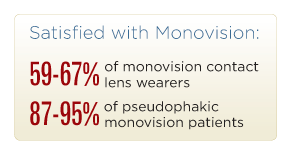
Greater satisfaction with pseudophakic monovision can be attributed to problems inherent in contact lens wear—such as lens handling difficulty, dry eyes and discomfort. In these satisfaction studies, few patients in either scenario noted failure of neuroadaptation as the main reason for dissatisfaction.
Success with Limited Screening
Although we recommend a more thorough patient selection process, a recent study was done on cataract monovision patients who underwent very limited pre-surgical screening. A prospective study of 140 pseudophakic monovision cases reported 92% satisfaction. This is remarkable considering:
- Few of the patients had tried monovision with contact lenses.
- The surgeon’s only selection criterion was patients’ expressed interest in being less dependent on glasses.
- The only exclusion criterion was 2.00 D or more of astigmatism (toric IOLs were not used on any patients).
In this study, 95% of patients had 20/30 or better uncorrected distance acuity and 93% were J1 or better at near. Patients who were not happy cited the need for spectacles with certain visual tasks as the reason. While this study was not large, it demonstrates that pseudophakic monovision can result in a high proportion of happy patients—even with limited screening.
Advantages of Monovision
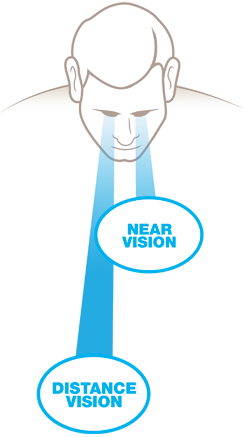
For patients motivated to reduce dependence on corrective eyewear, pseudophakic monovision offers several advantages:
- For patients with low corneal astigmatism, there is no out-of-pocket cost beyond the customary fee for cataract surgery.
- Treatment utilizes standard single-focus IOLs which pose no greater risk of glare, halos or dysphotopsia than conventional cataract surgery.
- In varying light conditions, there is less vision-quality variability than with multifocal IOLs.
- Monovision can be combined with toric lens implants to correct up to 4.50 D of corneal astigmatism.
Candidates
Monovision with cataract surgery is ideal for patients who are willing to accept some compromise in order to be as independent as possible from glasses. The best candidates are those who:
- Do not have strong ocular dominance
- Have greater suppression capacity
- Have successfully worn monovision contact lenses
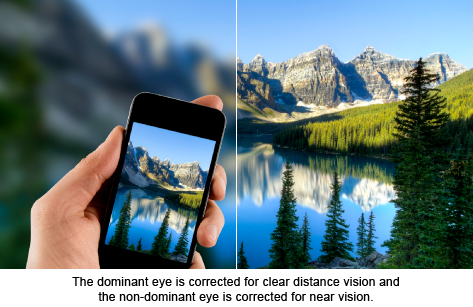
Successful monovision patients understand that they always have the option of using customized spectacles for extended near tasks or more visually critical activities like night driving.
Poor candidates have compulsive personalities, visually demanding occupations or hobbies, strong sensory ocular dominance or rivalry, and professions that require binocular vision—such as law enforcement, aviation and commercial driving.
Patient Selection
If you are well acquainted with patients, you will likely be able to easily determine if their personalities and occupations are suited to monovision. If not, a few standard questions or a short visual assessment survey can be helpful.
When patients’ personality and visual needs are suited to monovision, I recommend the following assessment process:
-
Ocular dominance and suppression capacity—
Determine which eye to target for near and distance by assessing oculomotor dominance. The hole-in-the-card test works well with the card held by the practitioner. To assess suppression capacity, I use the plus lens blur technique. A dense unilateral cataract can complicate suppression assessment but can also aid adjustment to monovision as patients have already adapted to suppression of one eye. -
Contact lens trial—
I recommend a contact lens trial whenever possible knowing that if patients tolerate this type of monovision, they will do even better with IOLs. Listen carefully to their comments about the experience and delineate whether concerns or complaints are related to monovision or dry eyes or contact lens discomfort. As mentioned previously, studies suggest contact lens trial failures are usually related to comfort issues rather than visual deficits. I recommend a trial of -1.75 to -2.00 D for the near eye with a reminder to patients that they may have to adjust their working distance for best results. Less anisometropia helps with adaptation and intermediate visual tasks. Plus, a slightly lower add power will be enhanced by up to 1.00 D of pseudoaccommodation routinely achieved with conventional IOLs. -
Review expectations—
Remind patients that there is no perfect fix for presbyopia and that all options have limitations. Remind them that corrective lenses may be needed for certain low light situations like night driving or extended reading. Explain that you can customize a spectacle prescription for those times when they need their best binocularity.
These simple guidelines will help you achieve success and satisfaction with cataract patients considering monovision.
Special Patients to Consider
Low myopes (-1.50 to -3.00 D) who have always had good reading vision are often challenging to please with cataract surgery. A discussion about monovision might be particularly worthwhile with this group of patients. Despite our best education efforts, it can be difficult for them to understand how daily activities will change if they are corrected for bilateral emmetropia.

Consider scheduling cataract surgery for low myopes 2 to 4 weeks apart so they can experience monovision in the interim. Ideally, the dominant eye should be treated first with vision targeted for distance. While performing routine follow-up care, you can help them determine if pseudophakic monovision is the best option. They may be forever grateful for your cautious approach. This strategy can also be helpful with early-presbyopic myopes desiring laser vision correction.
Conclusion
As active, visually-demanding baby boomers develop cataracts, they are increasingly seeing cataract surgery as an opportunity to become less dependent on corrective lenses. Pseudophakic monovision is an option that offers several advantages for motivated and carefully selected patients.